Geometric Wardian Cases vs Antique Glass Cloches for Humidity
If you’re growing ferns, mosses, fittonias, or anything else that sulks the moment the air gets dry, the enclosure you pick matters almost as much as how often you reach for the mister. Geometric wardian cases and antique glass cloches both build humid little microclimates, but they go about it in completely different ways. That difference shows up in airflow, plant health, and honestly, how much babysitting you’re signing up for. Here’s how the two actually stack up once you’ve lived with them for a while.
What Each Enclosure Actually Is
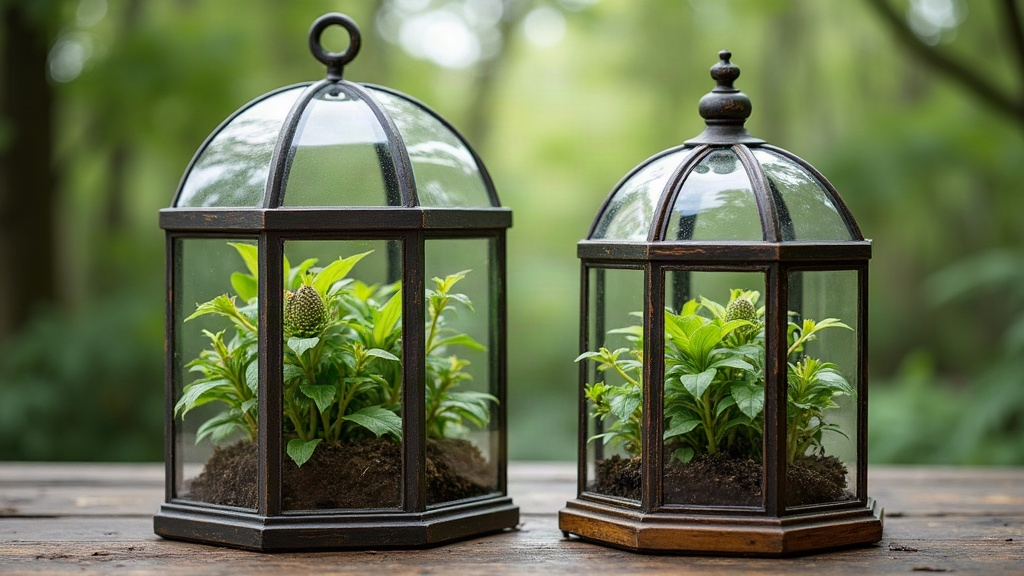
Geometric wardian cases are the modern, angular cousins of the original 19th-century Wardian boxes, those wood-and-glass crates botanists once used to ship live plants across oceans without losing half the cargo to salt air and neglect. Today’s versions trade the wood for metal frames with glass or acrylic panels. You’ll find hexagons, little pentagon “house” shapes, faceted domes, some with hinged doors, others with lift-off tops.
Antique glass cloches are a different animal entirely: single-piece blown or pressed glass bells, the kind French gardeners once set over seedlings to fend off frost. No seams, no doors, no vents. Just a dome sitting over a plant and whatever base you’ve chosen, soil, a saucer, maybe a decorative plinth.
Humidity Retention
- Wardian cases: the seams between panels and the gaps around doors let humidity leak out slowly, so expect to mist every 1-3 days depending on size.
- Cloches: a sealed glass dome traps moisture almost too well. Condensation beads up visibly on the inside, and humidity can hover near 90-100% for a week or longer between waterings.
Winner for pure humidity retention: glass cloches, no contest.
Airflow and Mold Risk
Here’s where wardian cases take the lead. Those hinged doors and panel gaps give you:
- Fresh air exchange, which cuts down on fungal and mold outbreaks
- A chance to spot-check a plant without cracking the whole thing open
- Gradual humidity cycling that mimics the rise and fall you’d actually get in a rainforest understory
Cloches, on the other hand, have zero airflow unless you physically lift them off now and then. Leave one sealed too long and you’re asking for trouble:
- Mold creeping across the soil surface or on dead leaf litter
- Fungus gnats throwing a party in all that stagnant moisture
- Condensation dripping straight onto plant crowns, which can rot things like African violets or moss in short order
If you’re keeping something that loves humidity but hates mold (nerve plants, selaginella, maidenhair fern), a wardian case with daily venting is almost always the safer bet long-term.
Plant Access and Maintenance
- Wardian cases usually open through a front or top door, so pruning, misting, swapping soil, none of it requires an engineering degree.
- Cloches have to come off the base entirely for any kind of upkeep. That’s fine if you’ve got a small, simple display, but it gets awkward fast with anything larger or top-heavy.
Light Transmission
Old hand-blown cloches often have a slight waviness to the glass, sometimes a green or amber tint if they’re genuinely antique. It scatters light in a way that looks lovely, honestly, but it can also cut intensity by 10-20%. Modern wardian cases tend to use clear glass or acrylic, which means more consistent light reaching the leaves. That matters if you’re growing anything beyond the usual low-light suspects like ferns and pothos.
Style and Decor Fit
- Wardian cases fit right into modern, botanical, or “urban jungle” spaces; the geometric shape works as a centerpiece on its own.
- Cloches lean vintage, French-cottage, apothecary-shelf territory, and they pair beautifully with a cushion of moss, a tiny orchid, or one standout specimen left to shine alone.
Cost and Availability
Genuine antique cloches, especially 19th-century French glass, can run anywhere from $80 to several hundred dollars depending on age and condition, and since nobody’s making more of them, stock is always limited. Geometric wardian cases span a wider range: basic metal-and-glass versions start around $30-40, while a designer brass or copper-framed piece can easily top $200.
Quick Decision Guide
| Priority | Best Choice |
|---|---|
| Maximum humidity, minimal misting | Glass cloche |
| Mold/fungus prevention | Wardian case |
| Easy daily access | Wardian case |
| Vintage aesthetic | Glass cloche |
| Larger multi-plant display | Wardian case |
| Budget-friendly new piece | Wardian case |
Final Verdict
Neither one wins outright. It really comes down to what you’re growing and how disciplined you are about checking on it. Antique glass cloches shine for small, single-specimen setups where you’re willing to vent them periodically and keep an eye out for mold. Geometric wardian cases are the more forgiving, practical pick for most humidity-loving collections, giving you better airflow control and far easier day-to-day care without giving up much on the humidity front.
Still torn? Start with a wardian case. You can always wrap it tighter in plastic for an extra humidity boost later, but there’s no easy way to add ventilation to a sealed cloche once it’s closed up.