Adjusting Terrarium Grow Lights & Timers for Short Winter Days
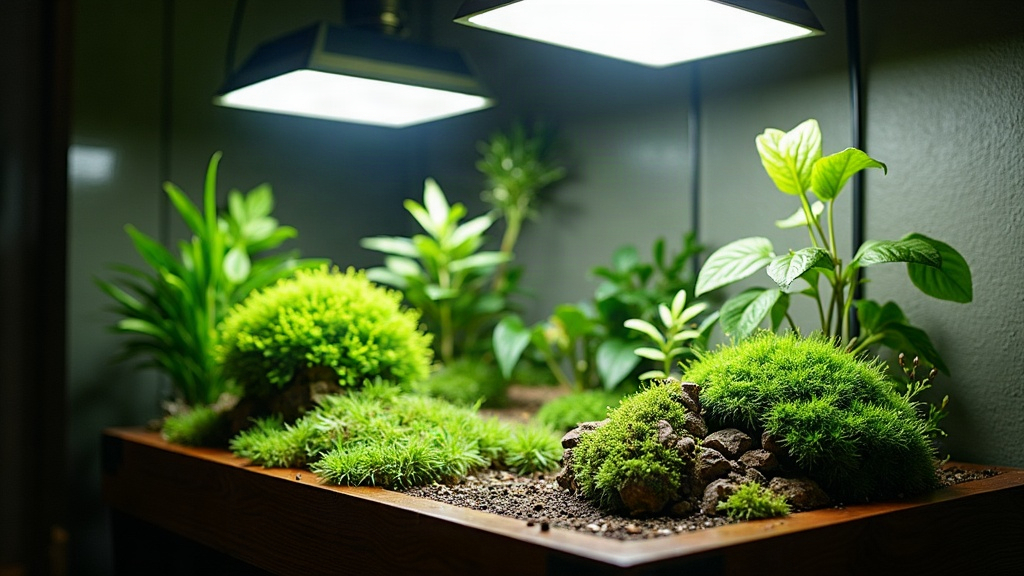
Why Winter Changes Everything for Terrarium Light
Your terrarium might live indoors, tucked away from wind and frost, but it’s not immune to the seasons. Light pouring through a nearby window shifts in both duration and color temperature once November hits, and the ambient glow in your living room gets noticeably dimmer and bluer. Plants don’t just care about how many hours the lights are on. They respond to total daily light exposure, and that total governs photosynthesis, dormancy cues, and how fast (or slowly) new growth appears. When the sun stops pulling its weight, your grow light suddenly makes up a much bigger slice of your plant’s light “diet.” The timing has to catch up.
Step 1: Extend Your Photoperiod Gradually
Most terrarium plants, think ferns, mosses, fittonia, pileas, the usual small tropical foliage crowd, do well on 10-12 hours of light during their active growth months. Come winter, a lot of growers bump that up to 12-14 hours to make up for the weaker daylight outside. But don’t rush it.
- Add 15-30 minutes to your timer every few days instead of jumping from 10 hours straight to 14.
- Stay under 14 hours for most tropical species. More light than that doesn’t help, it just scrambles their natural rest cycle and adds stress.
- Succulents and cacti are the odd ones out here. They actually want less light in winter, around 8-10 hours, to mimic the dormancy they’d experience outdoors.
Step 2: Shift the Timer Schedule, Not Just the Length
Winter days get dark earlier and start later, so it’s worth shifting your “on” window rather than just stretching it. Line it up with when you’re home and when the room is darkest anyway:
- Morning start: Push the lights on earlier, say 6:30 AM instead of 8, to cover for the late sunrise.
- Evening extension: Let the lights run further into the evening, since natural light is often gone by 4 or 5 PM this time of year.
- Avoid pure darkness-to-darkness: Plants still need a steady, predictable rhythm. Don’t let the total light hours bounce around from one day to the next.
Step 3: Check Light Intensity, Not Just Duration
Winter’s also a good excuse to check whether your light is actually strong enough, since LEDs dim with age and dust collects faster than most people expect.
- Wipe down panels or bulbs once a month. A thin layer of dust can knock output down by 20-30%, which is a lot more than it sounds.
- With the room itself dimmer, your grow light’s brightness matters more by comparison. If growth looks stretched or washed out, try moving the fixture 2-4 inches closer to the canopy.
- Keep an eye out for leggy, stretched stems reaching toward the light. That’s usually a sign the intensity is off, not the duration.
Step 4: Watch for Signs You’ve Overcorrected
It’s just as easy to swing too far the other way, running lights too long or too bright in an effort to fix things. Signs to watch for:
- Leaf scorch or bleaching: the light’s probably too close or too intense.
- No new growth despite long light hours: the plant may just need its winter rest, not more light thrown at it.
- Algae on the soil or glass: usually means too much light duration paired with high humidity.
A Simple Winter Timer Routine
For a typical mixed-foliage terrarium, here’s a rough seasonal template:
- Early winter (Nov-Dec): 12 hours on, start time shifted 30-60 minutes earlier.
- Deep winter (Jan): 12-13 hours on, plus an intensity check and a cleaning pass.
- Late winter (Feb): Start tapering back down toward 10-11 hours as daylight returns.
A programmable timer with battery backup is worth the few extra dollars. Winter means more strain on home electrical systems, and a quick power blip can reset a cheap timer and throw off your whole schedule without you noticing for days.
Final Thought
Winter doesn’t have to knock your terrarium off balance. It just asks for a bit more attention: stretch the photoperiod slowly, move the timer window to match the darker days, and actually look at your plants rather than just trusting the clock. Do that, and the terrarium should sail through the darkest months and come out the other side ready for spring.